Storage Sites
California Resources Corporation (CRC) has applied for several Class VI permits to the U.S. Environmental Protection Agency (EPA) for underground storage sites across California in the San Joaquin and Sacramento basins.
In late 2024, CRC’s CTV I received EPA permits for CO2 injection and storage in California and began CO2 injection at the site in May 2026, marking a key milestone in advancing carbon capture and storage in the state.
Carbon TerraVault Potential Storage Capacity
46 MMT
23 MMT
71 MMT
34 MMT
17 MMT
102 MMT
27 MMT
32 MMT
TOTAL POTENTIAL CAPACITY (as of May 2026) = 352 MMT
CTV I
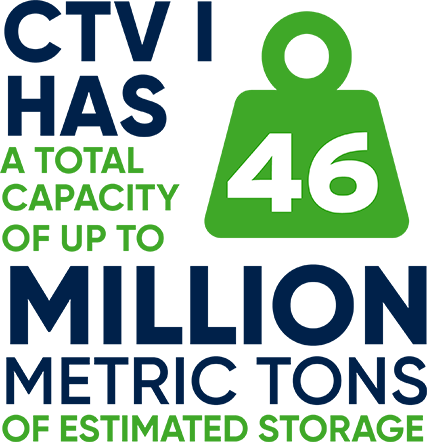
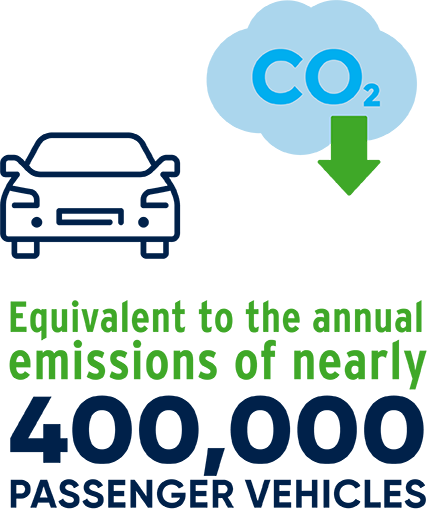
Carbon TerraVault I (CTV I) is a carbon capture and storage (CCS) site composed of two depleted oil and natural gas reservoirs – “26R” and “A1-A2”. Together, these reservoirs make up CTV I, which is located within the CTV Clean Energy Park at Elk Hills Field in Kern County, California. With a total estimated capacity of up to 46 million metric tons (MT) of storage, the reservoirs are permitted to store up to 1.6 million MT of CO2 per year, equivalent to the annual emissions of nearly 400,000 passenger vehicles, offsetting the impact of more than 200,000 American household's energy use.
The first CO2 injection at CTV I took place in May 2026, with injections beginning in the 26R reservoir—marking a historic milestone for California as the state’s first Class VI carbon storage injection and a major step forward for in-state CCS development.
Elk Hills Field is an attractive site for CCS projects due to its unique geology featuring multiple depleted reservoirs ideal for CO2 storage. The field also operates under the state’s rigorous environmental permitting process which meets the world’s highest regulatory standards. The CTV Clean Energy Park enhances its appeal by eliminating the need for off-site CO2 transportation—CCS projects can be located near the injection points, offering a streamlined and efficient solution for companies leading the energy transition.
Beyond emissions reduction, CCS projects at Elk Hills offer immediate and long-term benefits to local communities, the economy, and the environment. The expansive and rural Elk Hills Field spans nearly 75 square miles and operates without impacting local communities and includes more than 25,000 acres of dedicated habitat conservation lands.
California’s First CCS Project
In December 2024, CTV received Class VI permits from the U.S. Environmental Protection Agency (EPA) to inject and store CO2 underground into the 26R reservoir at Elk Hills. In January 2025, CTV announced California’s first CCS project. Through its joint venture with Brookfield (CTV JV), the project will permanently store up to 100,000 metric tons of CO2 per year from the Elk Hills cryogenic gas plant. First injection began in May 2026. This project is a major milestone for CRC and the broader energy industry, having received the nation’s first EPA Class VI permits for use of depleted oil and natural gas reservoirs to sequester CO2. The Elk Hills cryogenic gas plant processes gas from the Elk Hills Field and supplies inlet gas to CRC’s 550-MW Elk Hills Power Plant.


CTV II & III
In May 2022, CRC applied for two Class VI permits for 94 million metric tons of permanent CO2 storage for two new CCS vaults – CTV II and Ill – in the Sacramento basin.
CTV IV
In May 2023, CRC applied for a Class VI permit for 34 million MT of permanent CO2 storage for the CTV IV CO2 reservoir in the Sacramento Basin.
CTV V
In August 2023, CRC applied for a Class VI permit for 17 million MT for the CTV V CO2 reservoir in the Sacramento Basin.
CTV VI
In August 2024, CRC submitted an approximately 102 million MT Class VI permit to the EPA for the CTV VI CO2 reservoir in Central California.
CTV VII
In February 2026, CRC submitted an approximately 27 million MT Class VI permit to the EPA for the CTV VII CO2 reservoir in Kern County.
CARBONFRONTIER
In January 2023, Aera Energy LLC (Aera), which as of July 1, 2024, is a CRC subsidiary, applied for a Class VI permit for its CarbonFrontier CCS project for up to 40 million metric tons of permanent CO2 storage at Aera’s Belridge field in Kern County.
CDMAs and MOUs
Carbon Dioxide Management Agreements (CDMAs) and Memorandums of Understanding (MOUs) are preliminary, non-binding agreements that establish the economic and contractual framework for carbon capture and storage projects, paving the way for definitive agreements and final investment decisions. Through CDMAs and MOUs, CTV and Carbon TerraVault JV HoldCo, LLC (CTV JV) have partnered with several companies to support carbon capture and storage initiatives across the state. These agreements outline plans to sequester significant volumes of CO2 annually from various low-carbon energy projects, including clean ammonia and hydrogen, renewable dimethyl ether, renewable gasoline, waste-to-energy production, and ultra-low emission power. Collectively, these efforts highlight the growing potential of CDMAs and MOUs in advancing carbon storage and supporting the transition to a lower-carbon energy future.
The Elk Hills Field is "one of the premier CO2 sequestration sites in the U.S. ...an optimal site for the safe and secure sequestration of CO2"
California Energy Commission

As we transition toward a net zero future, we believe innovative solutions such as carbon capture and storage projects can create additional energy transition jobs in our state while also providing Californians with local, responsibly produced energy.
Together We Power California
CRC's workforce is dedicated to California and our local communities, and safely advancing solutions for reducing emissions that are aligned with the state’s emissions reduction goals.
I’m honored to be able to help provide innovative decarbonization technology solutions like Carbon TerraVault that’s going to revolutionize how we combat climate change here in California.
Vice President, Health, Safety and Environmental (HSE), and Sustainability